
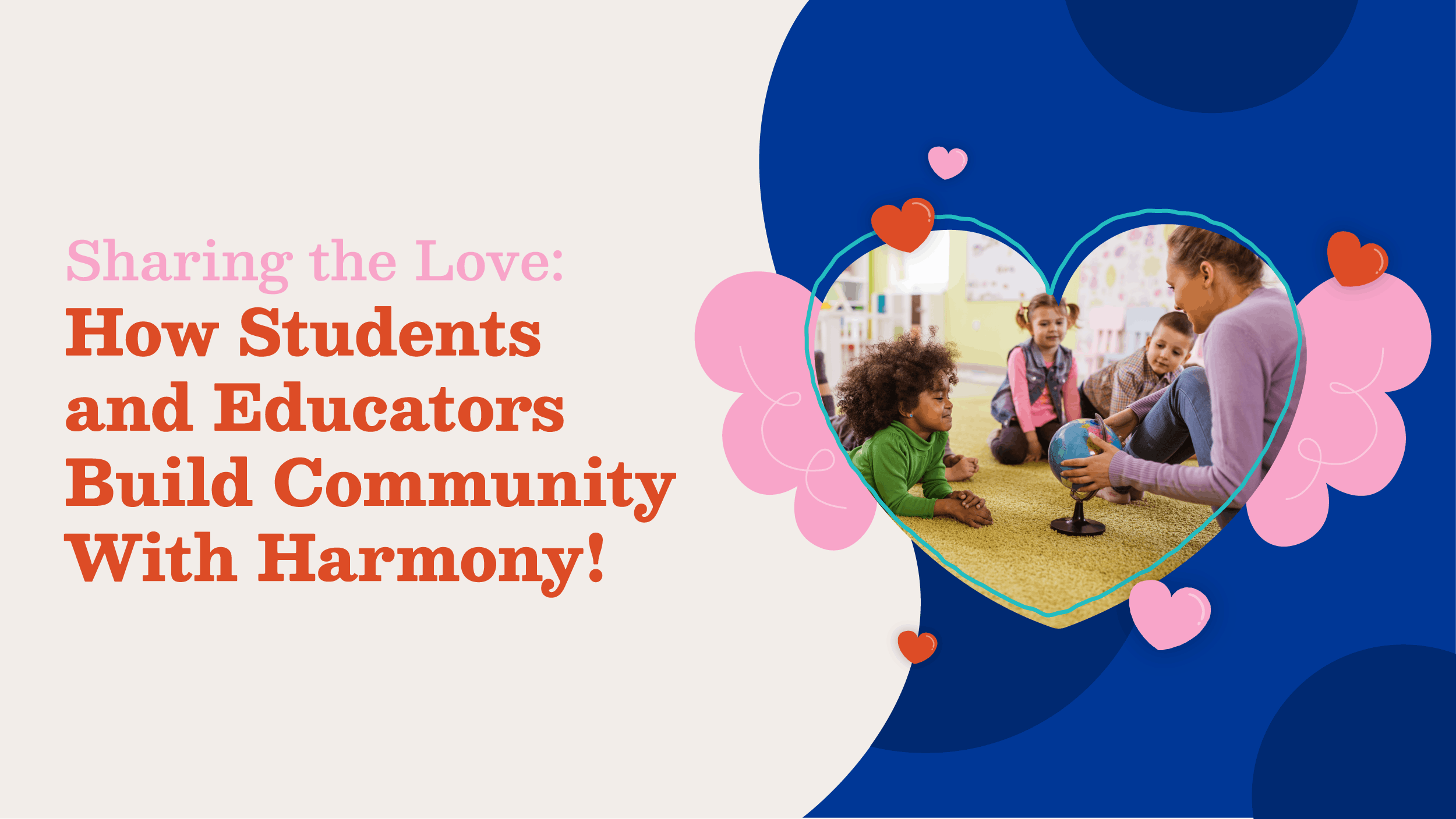
Sharing the Love: How Students and Educators Build Community With Harmony!
It’s that time of year to celebrate love in all its forms — love for ourselves, care for one another, and connection within our communities.
We asked our Educator Advisory Group to share how they use Harmony activities to help students thoughtfully exercise their voice and choice, build harmonious peer relationships, and nurture a strong sense of belonging in their learning spaces.

Student input is so crucial when it comes to Harmony in our academic spaces. Asking students to check in when arriving, and sharing how they feel about observable behaviors in the school community are just two routines that I incorporate on a daily basis with my 5th graders. This allows them to take ownership and hold themselves accountable through self-assessment. They have the opportunity to reflect on their choices, as well as on how the group can meet their personal and community goals. – Lee Eisen, 5th Grade, Brooklyn, New York
I incorporate the Harmony Curriculum in my Tier 2 small group meetings. During a small group meeting, it is important that every child feels “seen” and “heard”. I give every student an opportunity to use their voice by asking them open-ended questions that allow them to share their experiences and opinions. The other students practice active listening by leaning in and tracking with their eyes and bodies. They are also encouraged to ask follow-up questions, staying on the topic.
Many of the students I work with in small groups have suffered trauma in their lives. They are not usually the students who will actively raise their hands and participate in class when it is a large group. Small group settings offer a safe place for students to practice using their voice to gain self-confidence.
I love to offer students opportunities to show their learning in different ways during group time or during a counseling curriculum lesson. By offering students choices to demonstrate their learning, I can learn about the child’s preferred learning styles and their interests/talents. Sometimes students may choose to answer questions by drawing their answers, or using puppets/drama, or just talking about their answers instead of writing them. – Deborah Goodman, School Counselor, Elementary level, Las Vegas, Nevada
Student voice, student choice in all out-of- school time (OST) programming is the key to a successful structure. So many parts of the Harmony Curriculum can be used to design and implement quality programming.One of our favorite tools to use is the Quick Connection Cards to help youth find their voices! Our high school mentors, who support seven of our OST sites, love to lead these connections. Our youth love it too! Our mentors carry the printed cards in the back of their name tag badges to have an immediate plan to help as needed. We work with our mentor staff on how to modify or adjust a card as needed. This also gives our teens a voice and choice as well! These cards have been highly successful during our month-long summer program offering any teacher or staff member a fast, dependable way to engage with kids they may not be familiar with since many schools merge together for this camp experience. These cards really are a “quick connection” for any program! – Jennifer Wienke, Out-of-School Time Coordinator, Fairbanks, Alaska

Using the Harmony Everyday Practices helps our classroom community truly thrive.Each month, our class creates a Harmony Promise — with our Harmony Goals— for how we want to learn and grow together. These goals become part of our daily Morning Meeting, guiding the way we treat one another and approach our day. At the end of the month, students reflect together on what we’re doing well and what still needs work. Each month we revise our Harmony Promise based on their insights, ensuring that our classroom community is always growing, responsive, and student-driven! – Olivia Leone, 5th Grade, Milburn, New Jersey
I integrate the Harmony Curriculum with my students as a Reading Interventionist. Each day, I learn about how my students are feeling, what activities they participate in after school, and what they are interested in with the support of the Harmony Curriculum. I pull from a list of questions as well as the Quick Connection Cards to initiate conversation. The conversations prompt their writing.
I primarily teach early childhood students and the Quick Connection Cards assist myself and students in regard to my teaching of literacy. I’m able to learn what particular areas of reading and writing I need to work on with students through encoding, which allows me to see how students spell and write particular words. This informs how I teach students to decode. Decoding allows children to learn spelling patterns and blend sounds, which contributes to building fluency and confidence. I get to know students and their feelings.
These methods assist in continuing to establish and nurture relationships with students. – Stephanie M. Johnson, Reading Interventionist, Columbia, South Carolina
Join our Next Webinar!
Learn more about how school leaders can support systems for developing a strong sense of belonging and a love for community.